
Notably, Ukrainian forces disabling bridges across the Dnipro river and attacking Russian supply lines made it very difficult for Russia to defend the occupied territory.
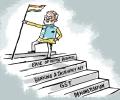
As the Ukraine conflict impacts the global GDP, India is projected to grow by 6.4 per cent in 2022, slower than the last year's 8.8 per cent but still the fastest-growing major economy, with higher inflationary pressures and uneven recovery of the labour market curbing private consumption and investment, according to a UN report. The UN Department of Economic and Social Affairs said in its World Economic Situation and Prospects (WESP) report released on Wednesday that the war in Ukraine has upended the fragile economic recovery from the pandemic, triggering a devastating humanitarian crisis in Europe, increasing food and commodity prices and globally exacerbating inflationary pressures. The global economy is now projected to grow by only 3.1 per cent in 2022, down from the 4.0 per cent growth forecast released in January 2022.

'Higher than expected inflation in the US or the European Union, faster than expected tightening by the major central banks, break out of a war in Europe, and withdrawal of portfolio equities from the emerging markets are factors which can result in equity market corrections.'

The market breadth ended weak on the BSE with 2,086 shares declining and 893 shares advancing.

The government should not go in for an 'aggressive fiscal consolidation' in the upcoming Budget as global risks have not abated, RBI Monetary Policy Committee (MPC) Member Ashima Goyal said on Wednesday. Goyal further said subsidies are expected to come down as food and energy inflation moderates. WPI inflation in food articles in November was 1.07 per cent against 8.33 per cent in the previous month.
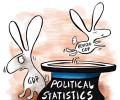
The Economic Survey 2022-23 (FY23), to be presented a day before Union Budget 2023-24 (FY24), is likely to project India's real gross domestic product (GDP) growth between 6 per cent and 7 per cent for FY24, Business Standard has learnt. The broader theme of the Survey could be on how India has dealt with two years of a global pandemic and the ongoing geopolitical disturbance, the strengths and weaknesses that emerged, and what lessons may be learnt. The much-awaited Survey will be the first one by Chief Economic Advisor V Anantha Nageswaran and his team in the finance ministry's economic division.
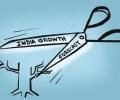
The International Monetary Fund (IMF) on Tuesday cut its projection of India's economic growth in 2022 to 6.8 per cent, as it joins other global agencies that have trimmed forecasts. The IMF had in July projected a gross domestic product (GDP) growth of 7.4 per cent for India in the fiscal year that started in April 2022. Even that forecast was lower than 8.2 per cent projected in January this year. India had grown at 8.7 per cent in 2021-22 fiscal (April 2021 to March 2022).
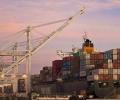
Exports declined for the fourth-consecutive month by 10.3 per cent year-on-year to $34.98 billion in May, while the trade deficit widened to a five-month high of $22.12 billion. According to the data released by the commerce ministry on Thursday, key export sectors recording negative growth include petroleum products, gems and jewellery, engineering goods, ready-made garments of all textiles and chemicals. Imports also declined 6.6 per cent, six-month in a row, to $57.1 billion against $61.13 billion in the same month last year, the data showed.
The situation in Greece worsened with banks closed for a 2nd week.

Tough conditions imposed by global lenders could cause an outcry.

The Reserve Bank on Wednesday allowed inbound travellers from G20 nations arriving at select airports to use the popular UPI for making payments in the country. Later, the RBI also proposes to extend the Unified Payments Interface (UPI) facility to travellers from all countries. UPI is a system that powers multiple bank accounts into a single mobile application, merging several banking features, seamless fund routing & merchant payments into one hood.

'The government is trying to kickstart the investment cycle in India and while the corporate investments are yet to gather momentum, there are early signs of the same.'

Eurosceptics lined up to laud Greek democracy for disowning what some cast as the oligarchy

Ahead of the Union Budget for 2023-24, Budget makers have welcomed the global consensus view that India will remain one of the bright spots in calendar year 2023. But there is some alarm over the grim global situation and how that might impact the Centre's projections and assessments for next financial year. The big global headwinds include a deep and sustained recession in the West, including India's biggest trading partners in North America and Europe, continuing volatility in commodity markets, and renewed Covid-19 fears, as lifting of strict curbs by China could potentially lead to a massive spread again.

Significantly, for the first time, the FATF put Myanmar in the "high risk jurisdictions subject to a call for action", often referred to as the watchdog's black list.

Pakistan will remain on the 'grey list' of the Financial Action Task Force (FATF) until it further demonstrates that action is being taken against Jamaat-ud-Dawah chief Hafiz Saeed and Jaish-e-Mohammed founder Masood Azhar who are listed as global terrorists by the United Nations, the global anti-money laundering and terror financing watchdog said on Thursday.

The rupee depreciated further by 13 paise to hit a new life-time closing low of 82.30 against the US dollar on Friday as a firm American currency and risk-averse sentiment among investors weighed on the local unit. Moreover, a negative trend in domestic equities and elevated crude oil prices sapped investor appetite, forex traders said. At the interbank foreign exchange market, the local currency opened at 82.19, then fell further to 82.43. It finally settled at an all-time low of 82.30 against the American currency, registering a decline of 13 paise over its previous close.

In a move intended to reassure the jittery financial markets, the European Commissioner for Monetary Affairs, Olli Rehn, on Thursday stressed the fact that the European Union and the International Monetary Fund (IMF) were aware of the need to move swiftly to help an overly indebted Greece.
The employment situation remains dire. Whatever can be done to promote greater low-skill employment should be pursued aggressively, advises former chief economic adviser Shankar Acharya.

Just when you thought that the world was slowly slipping away from the crippling recession that had it in its vice-like grip since 2008, here comes the Irish economic crisis.

Even as the bilateral relationship between the two neighbouring countries remains hostile, there is growing coordination between India and Pakistan on one multilateral forum - the World Trade Organization (WTO). Both countries have made two joint submissions at the WTO as co-sponsors in the past two months. In June, Pakistan joined India, Cuba, and 44 African countries, seeking sufficient flexibility in intellectual property rights for developing countries to fight the Covid-19 pandemic.

The SJB has begun to collect signatures from MPs for the no-confidence motion, according to media reports.

There is no direct impact of the Russia-Ukraine crisis on India in terms of bilateral trade but a surge in oil prices poses considerable risk to the economy, an analyst report said on Friday. International oil prices which have surged past $100 per barrel "pose risks to external stability and currency movement," a Bank of Baroda Economics Research report said. Russia has launched military operations against Ukraine, stoking fears of significant disruption in the region, including loss of life. The West is ramping up financial sanctions against Russia and support for Ukraine.
European Union leaders are expected to clear the way for releasing 31.5 billion euro ($41 billion) in urgently-needed financial assistance for debt-stricken Greece at their two-day summit which opens in Brussels today.

German Chancellor Angela Merkel had assured the Greek leaders her continued support for the country to remain in the euro zone when she last Wednesday made her first visit to Athens in nearly three years.

The V-shaped rebound has been aided by a gush of liquidity flooding the global financial system, thanks to balance sheet expansion.
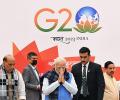
Will G20 showcase an India that is inclusive, culturally rich, diverse and tolerant, asks Ramesh Menon.

Pakistan is on the verge of strong action by FATF, given its inadequate performance, whereby it managed to pass in only six of 27 items, an official privy to the development said.

The Financial Action Task Force (FATF) on Friday retained Pakistan on its 'grey list' for failing to check money laundering, leading to terror financing, and asked Islamabad to investigate and prosecute senior leaders and commanders of United Nations-designated terror groups, including Hafiz Saeed and Masood Azhar.
Former Spanish Finance Minister Rodrigo Rato is almost certain to take over as the new managing director of the International Monetary Fund after the United States backed his candidature for the top job.

Saeed-led JuD is the front organisation for the Lashkar-e-Tayiba which is responsible for carrying out the 2008 Mumbai attack that killed 166 people, including six Americans.

With 75 per cent of votes counted, the ND party was leading with 39.6 per cent of total votes heading towards a majority in the 300-member Greek Parliament, while Tsipras' leftist Syriza was behind with 31.6 per cent of total votes, CNN reported.

Finance Minister Pranab Mukherjee on Wednesday said Indian markets cannot remain immune to the Eurozone debt problems and will feel the impact if the $1 trillion bailout package by the European Union and the International Monetary Fund does not inspire confidence.

Eurozone leaders have agreed on a bailout package of nearly $1 trillion (750 billion euro) for Greece, as part of their concentrated efforts to prevent the debt crisis contagion from spreading to other nations.

The IMF has encouraged both the UK and the EU to work collaboratively towards a smooth transition.
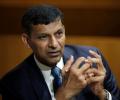
India needs foreign exchange buffer reserves to insulate itself from exchange rate volatility as we have "no friends" for swap lines and Japan was the only country that helped during the taper tantrum in 2013, former RBI Governor Raghuram Rajan said on Tuesday. Participating in a virtual event organised by economic think tank NCAER, Rajan said during the taper tantrum in 2013, India asked for swap lines, and only country who helped was Japan. "We need this (foreign exchange) reserve buffer to insulate ourselves because we have no friends.

The FATF continuing Pakistan in the 'Grey' list means its downgrading by IMF, World Bank, ADB, EU and also a reduction in risk rating by Moody's, S&P and Fitch.

Democracy, nation-state and globalisation can't go together; we can have at the most two at one time, says Dani Rodrik.
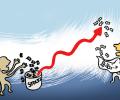
While enjoying long-awaited economic good times - and hoping they will last as long as possible - some caution and some prudence might be the best protection against bad surprises, says Claude Smadja.

Reserve Bank Governor Shaktikanta Das on Thursday said the central bank's asset purchases, aimed at mitigating COVID-19-related liquidity stress in the system, did not dilute its balance sheet or compromise on core principles of central banking. In the wake of the pandemic, the RBI undertook several conventional and unconventional measures. "Unlike many central banks, the RBI's asset purchases did not dilute its balance sheet and hence, did not compromise on core principles of central banking," Das said while addressing an event organised by the Bombay Chamber of Commerce. These purchases were confined to risk-free sovereign (government) bonds including state government securities only, he said.
